April Birds: Nesting Season-What Birds Are Active Now?
The Calendar Year may get paid commission for purchases made after clicking a link on this page.
This website is for inspiration purposes only. The content provided is meant to spark creativity and ideas, not to serve as professional advice or as endorsement.
I’ll be honest with you: April is my absolute favourite month for birds. Everything happens at once. Migrants are flooding back from Africa and beyond, resident birds are singing their hearts out, and the hedgerows and woodlands are suddenly alive with movement and noise after months of relative quiet. The light is better, the mornings are earlier, and there’s this incredible sense of abundance after the long wait of winter. I’ve been researching this month’s birds and, as always, I’ve gone deep into the symbolism and folklore attached to each one. Some of it surprised me. So grab a coffee, get comfortable, and let’s talk about the birds that make April worth celebrating.


1. The Cuckoo – The Bird That Announces Itself First
Before I even think about getting outside in April, I’m already listening for the cuckoo. That unmistakable two-note call, drifting across farmland, woodland, and open heath, is one of the most recognisable sounds in the natural world. When I hear it for the first time each year, something genuinely shifts in me. Winter is over. Spring has won.
The cuckoo arrives in the UK and Europe from sub-Saharan Africa in April, and similar cuckoo species make spring appearances across Asia and North America. Because of their remarkable migration, scientists now track individual cuckoos by satellite, and following those journeys online has become genuinely addictive.
Symbolically, the cuckoo is connected to transformation, time, and the marking of seasonal change. In many European folk traditions, hearing the cuckoo for the first time in spring was considered an omen. Counting how many times it was called was said to predict how many years you had left to live, or how many years until you married, depending on who you asked. Either way, people paid attention to it.
Beyond folklore, the cuckoo also represents the complex side of nature. It lays its eggs in other birds’ nests, and that strategy, called brood parasitism, is fascinating and slightly unsettling in equal measure.
I’d recommend the BTO’s cuckoo tracking project for anyone wanting to follow individual cuckoos on migration. The RSPB’s cuckoo page is also excellent.

2. The Nightingale – Everything the Poets Said Is True
I spent years assuming the nightingale was slightly overhyped. Then I heard one on an April evening in a scrubby bit of woodland, and I immediately understood why poets have been writing about it for thousands of years. The song is extraordinary. Rich, complex, loud, and endlessly varied, it pours out of dense undergrowth with a power that seems impossible from such a small bird.
Nightingales arrive in the UK from West Africa in April, and related thrush-nightingale species appear across Europe and Asia at the same time. In North America, the Wood Thrush and Veery carry that same quality of rich, liquid song that stops people in their tracks.
Symbolically, the nightingale is one of the most celebrated birds in human culture. In Persian poetry, it represents the soul’s longing for beauty and divine love. In Greek mythology, the nightingale’s song carries grief and transformation. John Keats wrote his famous ode to it after hearing one in a garden in Hampstead, and the poem captures that feeling of being almost overwhelmed by beauty.
More broadly, the nightingale represents the idea that extraordinary things can hide in ordinary places. Because it sings from dense cover, you often hear it without ever seeing it. That mystery is part of its power.
April evenings near scrub, bramble, and woodland edge are the best time and place to listen. Arrive at dusk, stand quietly, and wait.
The RSPB nightingale page includes the best locations to hear one. For North American thrush songs, AllAboutBirds is the place to start.
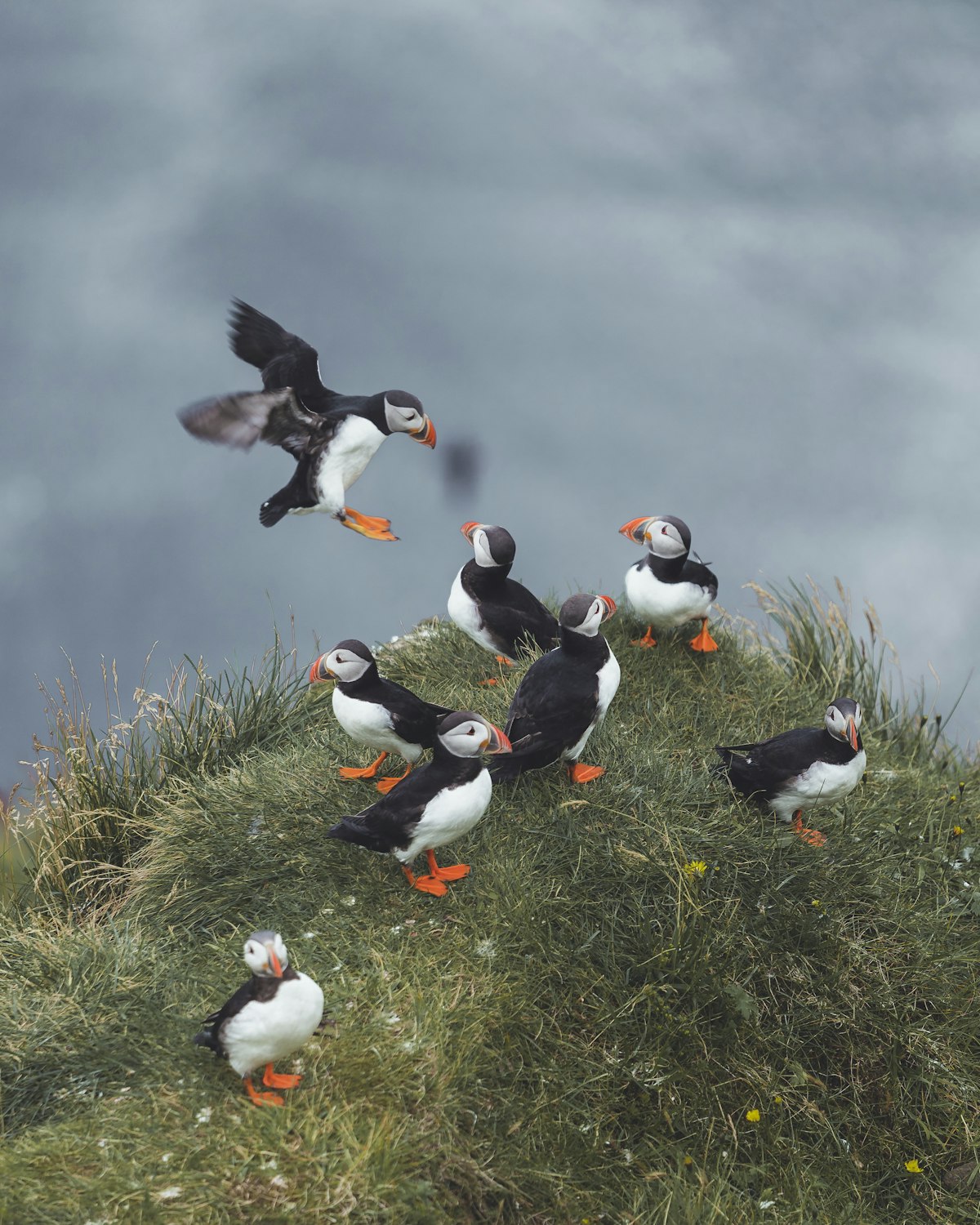
3. The Puffin – Comedy, Colour, and the Open Sea
I find it almost impossible to talk about puffins without smiling. They are objectively ridiculous, and I mean that as the highest possible compliment. Stocky, upright, with that extraordinary multicoloured bill and those bright orange feet, the puffin looks like someone designed a bird specifically to delight children. And yet, beneath all that charm, puffins are serious ocean travellers.
Puffins spend the winter months far out at sea, living entirely on the open ocean. Then, in April, they return to their cliff-top and island colonies to breed. Colonies in the UK, Iceland, Norway, and along the North Atlantic coast of North America burst back into life as thousands of birds return to the same burrows they used the previous year.
Symbolically, puffins are associated with resilience, resourcefulness, and the idea of thriving in difficult conditions. In Norse and Icelandic culture, puffins were deeply practical symbols: they provided food, feathers, and oil, and their return each spring marked the beginning of a more abundant season. More recently, puffins have become symbols of conservation and the importance of protecting marine environments.
Watching a puffin land, which involves a certain amount of controlled chaos, is one of the genuinely joyful wildlife experiences available in the northern hemisphere. I highly recommend planning a trip to a puffin colony if you haven’t already.
The RSPB’s guide to puffin watching locations is a great starting point. For North Atlantic colonies, Project Puffin by Audubon does incredible conservation work.

4. The Swift – The Bird That Never Has to Land
The swift might be the most extreme bird on this list, and that is saying something, given we’ve already talked about ospreys and puffins. Swifts arrive in the UK and across Europe in late April, screaming in from their wintering grounds in central Africa, and from that moment they fill the sky above towns and cities with their scythe-shaped silhouettes and piercing calls. That sound, sharp and urgent, echoing off rooftops on a warm April evening, is one of the sounds I associate most strongly with the feeling that summer is genuinely coming.
What makes swifts so astonishing is that, outside of nesting, they never need to land. They eat, drink, and sleep in the air, and can remain airborne for up to ten months at a stretch. Young swifts that fledge from their nest sites may not touch a solid surface again for two or three years. Because of that, the swift represents freedom and endurance in a way that few other creatures can match.
Symbolically, swifts are associated with speed, liberation, and living fully in the present moment. In various folk traditions, swifts screaming around a church tower or rooftop were considered protectors of the building. Their arrival was celebrated as a sign of long, warm evenings ahead. In that sense, the swift doesn’t just arrive in April; it transforms the feel of the season entirely.
Swift numbers have declined significantly due to the loss of nesting sites in older buildings. Installing a swift nest box is one of the most direct things you can do to help.
The RSPB swift page includes guidance on nest boxes. For North American readers, the similar Chimney Swift is covered beautifully at AllAboutBirds.

5. The Hoopoe – The Bird That Looks Like It Shouldn’t Exist
The first time I came across a hoopoe in my research, I genuinely thought I was looking at a tropical bird that had been added to the wrong list. That crest, those pink-orange tones, the zebra-striped black and white wings – it looks extraordinary. And yet, hoopoes do turn up in the UK and across Europe in April. They migrating north from Africa and southern Asia. They’re more commonly seen across southern Europe, the Middle East, and Asia. But every April brings reports of hoopoe sightings in unexpected places, which makes them worth watching for.
Symbolically, the hoopoe carries remarkable cultural weight. In ancient Egypt, the hoopoe was associated with virtue and gratitude because of a folk belief that young hoopoes cared for their ageing parents. The Quran says the hoopoe appears as a wise messenger between King Solomon and the Queen of Sheba. In Persian poetry, particularly in Farid ud-Din Attar’s epic “The Conference of the Birds,” the hoopoe leads all the birds on a spiritual journey toward enlightenment. As a result, across many traditions, it represents wisdom, guidance, and the willingness to seek something greater than yourself.
In Israel, the hoopoe is the national bird, chosen partly for its cultural and historical resonance across the region. That combination of striking appearance and deep symbolic meaning makes it one of the most fascinating birds on this entire list. If you ever do spot one, consider yourself very lucky indeed.
For identification and sighting information, the RSPB hoopoe page is a good place to start. For global range and behaviour, BirdLife International covers the hoopoe in detail.

6. The Whitethroat -The Scrappy Little Warbler Nobody Talks About Enough
I want to make the case for the whitethroat, because I think it deserves far more attention than it gets. This lively little warbler arrives from sub-Saharan Africa in April, and the male immediately starts one of the most energetic territorial displays you’ll see from any small bird. He bounces up from a bush, delivers a scratchy, chattering song in mid-air, then drops back into cover. Then he does it again. And again.
Whitethroats are found across the UK and Europe in spring and summer, and similar warbler species perform comparable spring displays across North America and Asia. Once you tune into that scratchy, urgent song, you start noticing whitethroats everywhere along hedgerows, bramble patches, and scrubby field edges.
Symbolically, the whitethroat is associated with boldness, determination, and the willingness to put yourself forward, even when you’re not the biggest or most impressive presence in the room. That mid-air song display, performed repeatedly and with total commitment, feels like a lesson in self-belief.
What I love most about the whitethroat is its complete lack of subtlety. While nightingales hide in thickets and ospreys soar at height, the whitethroat throws itself into the open air and makes as much noise as possible. As strategies go, it seems to work.
The RSPB’s whitethroat page has identification tips and habitat information. For similar scrubby-habitat warblers in North America, AllAboutBirds covers Common Yellowthroat and Yellow Warbler well.

Resources I’m Using This April
Spring migration is one of the most dynamic and fast-moving events in the natural world. And there are brilliant ways to follow it in real time:
- BirdTrack by the BTO — log your sightings and watch migration unfold across the UK
- eBird by Cornell Lab — global sightings database and the best tool for tracking migration worldwide
- The RSPB — species guides, reserve information, and live nest cameras
- Audubon Society — essential for North American spring migration
- Merlin Bird ID App — identifies birds by sound, perfect for warblers and spring migrants
- BirdGuides — real-time rare bird alerts and sighting reports for the UK

Over to You
April is the month I’ve been waiting for all year. I genuinely want to know what you’re finding out there. Have you heard a cuckoo yet, that moment when the whole season seems to click into place? Maybe you’ve watched an osprey arrive back at a nest site. Or caught a kingfisher as a blur of blue above a river. Perhaps you’re in North America, and the warblers are trickling through your neighbourhood. And every morning walk is turning into an unexpected treasure hunt. Whatever April is bringing you, share it in the comments below. Because honestly, the more I research these birds and what they mean to people across the world, the more I think birdwatching is one of the best things a person can do with their time. Get outside, slow down, look up, and let me know what you find.


